
Flash Gordon - The Skragg Mission
Flash Gordon is the protagonist of a space opera adventure comic strip created by and originally drawn by Alex Raymond. First published January 7, 1934, the strip was inspired by, and created to compete with, the already established Buck Rogers adventure strip. The Flash Gordon comic strip has been translated into a wide variety of media, including motion pictures, television, and animated series. The latest version, a Flash Gordon television series, appeared on the Sci-Fi Channel in the United States in 2007–2008.

Flash Gordon - The Deadly Queen Mesala
Flash Gordon is the protagonist of a space opera adventure comic strip created by and originally drawn by Alex Raymond. First published January 7, 1934, the strip was inspired by, and created to compete with, the already established Buck Rogers adventure strip. The Flash Gordon comic strip has been translated into a wide variety of media, including motion pictures, television, and animated series. The latest version, a Flash Gordon television series, appeared on the Sci-Fi Channel in the United States in 2007–2008.


Flash Gordon - The Avenging Lizardmen
Flash Gordon is the protagonist of a space opera adventure comic strip created by and originally drawn by Alex Raymond. First published January 7, 1934, the strip was inspired by, and created to compete with, the already established Buck Rogers adventure strip. The Flash Gordon comic strip has been translated into a wide variety of media, including motion pictures, television, and animated series. The latest version, a Flash Gordon television series, appeared on the Sci-Fi Channel in the United States in 2007–2008.

Rip Kirby - Fatal Forgeries
Rip Kirby is an American comic strip created by Alex Raymond and Ward Greene featuring the adventures of private detective Rip Kirby. Run from 1946 to 1999, the strip was in the hands of writer/artist John Prentice for more than 40 years.


Flash Gordon - Sly Sea Wolves
Flash Gordon is the protagonist of a space opera adventure comic strip created by and originally drawn by Alex Raymond. First published January 7, 1934, the strip was inspired by, and created to compete with, the already established Buck Rogers adventure strip. The Flash Gordon comic strip has been translated into a wide variety of media, including motion pictures, television, and animated series. The latest version, a Flash Gordon television series, appeared on the Sci-Fi Channel in the United States in 2007–2008.


Flash Gordon - Sheng the Savage
Flash Gordon is the protagonist of a space opera adventure comic strip created by and originally drawn by Alex Raymond. First published January 7, 1934, the strip was inspired by, and created to compete with, the already established Buck Rogers adventure strip. The Flash Gordon comic strip has been translated into a wide variety of media, including motion pictures, television, and animated series. The latest version, a Flash Gordon television series, appeared on the Sci-Fi Channel in the United States in 2007–2008.


Flash Gordon - Rescue Mission Mercury
Flash Gordon is the protagonist of a space opera adventure comic strip created by and originally drawn by Alex Raymond. First published January 7, 1934, the strip was inspired by, and created to compete with, the already established Buck Rogers adventure strip. The Flash Gordon comic strip has been translated into a wide variety of media, including motion pictures, television, and animated series. The latest version, a Flash Gordon television series, appeared on the Sci-Fi Channel in the United States in 2007–2008.

You may also like
 |
 |
 |
 |
Flash Gordon - Queen of Darkness
Flash Gordon is the protagonist of a space opera adventure comic strip created by and originally drawn by Alex Raymond. First published January 7, 1934, the strip was inspired by, and created to compete with, the already established Buck Rogers adventure strip. The Flash Gordon comic strip has been translated into a wide variety of media, including motion pictures, television, and animated series. The latest version, a Flash Gordon television series, appeared on the Sci-Fi Channel in the United States in 2007–2008.

Popular Comics Titles on Flipbook

Popular Comics Titles on Flipbook
 |
 |
 |
 |
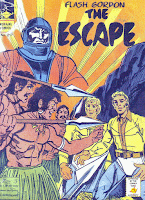
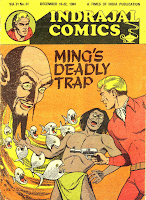
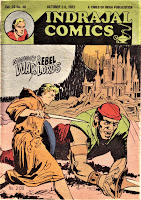
Flash Gordon - Plutonium Raiders
Flash Gordon is the protagonist of a space opera adventure comic strip created by and originally drawn by Alex Raymond. First published January 7, 1934, the strip was inspired by, and created to compete with, the already established Buck Rogers adventure strip. The Flash Gordon comic strip has been translated into a wide variety of media, including motion pictures, television, and animated series. The latest version, a Flash Gordon television series, appeared on the Sci-Fi Channel in the United States in 2007–2008.

You may also like
 |
 |
 |
 |
Rip Kirby - The Faraday Affair - The Formula of Dr. Hicks
Rip Kirby is an American comic strip created by Alex Raymond and Ward Greene featuring the adventures of private detective Rip Kirby. Run from 1946 to 1999, the strip was in the hands of writer/artist John Prentice for more than 40 years.
The Faraday Affair
Chip Faraday falls into Kirby's arms. 'She's beautiful!' remarks Edmond. I think, I'm missing something here. Let me try again. Chip Faraday falls into Kirby's arms, dead! Looks about right.
Someone heard clicking of a woman's hells, running away. The police asks Kirby not to get involved (we know that's never going to happen). Dorian offers her help. Kirby takes her to Barry's Agency where the deceased Faraday worked as a model. One of their employees, a certain Mousey Blake, meets Kirby and gossips for about 342 hours. Montgomery, a famous photographer, offers Dorian a modelling job. Rip and Edmond (that's what they call him in the French versions) visits Montgomery Studio at night. The killer keeps appearing and disappearing in the scene. We only know he has a scar on his wrist. It has been mentioned so many times, we know it must be an important piece of evidence. His next victim, Bud Kittrick, was the lover of Chip Faraday. Someone tries to attack Dorian with acid. Rip visits Mousey Blake and is ambushed by the killer who's been hiding in her apartment. He also gives Kirby a vital clue - yeah, you guessed it right - that he has a scar on his wrist. Now Kirby knows who the killer is!
The Formula of Doctor Hicks
Kirby is invited to deliver a lecture in Norchester University. His intuition tells him the dean needs Rip the detective more than Rip the scholar (we know that already). Dean's daughter Jill is getting married. So, Dorian, Jill's school-friend is also invited. Mr. Thatcher tells Kirby somebody killed his dog. Rip Kirby can't believe he was summoned only to investigate that, and he's right. Thatcher tells him there's also a formula that's missing. The formula of Doctor Hicks is a preparation of deadly virus. In the wrong hands, it can cause total annihilation. As it later turns out, the formula has already fallen into wrong hands. Kirby analyses the organs of the dead dog. Dr. Hicks doesn't believe Kirby is a capable detective. The formula miraculously reappears in Hicks' vault. Kirby, suspecting he's involved, calls cops on him. But it was a mistake. The real killer is still at large. On the wedding day, he comes for a final strike.

You may also like
 |
 |
 |
 |
Flash Gordon - Plant Attack
Flash Gordon is the protagonist of a space opera adventure comic strip created by and originally drawn by Alex Raymond. First published January 7, 1934, the strip was inspired by, and created to compete with, the already established Buck Rogers adventure strip. The Flash Gordon comic strip has been translated into a wide variety of media, including motion pictures, television, and animated series. The latest version, a Flash Gordon television series, appeared on the Sci-Fi Channel in the United States in 2007–2008.

More Flash Gordon comics on this site

More Flash Gordon comics on this site
|
|
|
|
Groo the Wanderer - Issue 30 - Sergio Aragones
Groo the Wanderer is a fantasy/comedy comic book series written and drawn by Sergio Aragonés, rewritten, co-plotted and edited by Mark Evanier, lettered by Stan Sakai and colored by Tom Luth. Over the years it has been published by Pacific Comics, Eclipse Comics (one special issue), Marvel Comics (under its Epic imprint), Image Comics and Dark Horse Comics.
Groo was one of the first widely successful creator-owned comics, one of the few successful humorous comic books in the United States (outside Archie Comics) during its time, and one of the longest-running collaborations in comic book history. In 2011 IGN ranked Groo 100th in the "Top 100 comic books heroes".

Groo was one of the first widely successful creator-owned comics, one of the few successful humorous comic books in the United States (outside Archie Comics) during its time, and one of the longest-running collaborations in comic book history. In 2011 IGN ranked Groo 100th in the "Top 100 comic books heroes".

Groo the Wanderer - Issue 28 - Sergio Aragones
Groo the Wanderer is a fantasy/comedy comic book series written and drawn by Sergio Aragonés, rewritten, co-plotted and edited by Mark Evanier, lettered by Stan Sakai and colored by Tom Luth. Over the years it has been published by Pacific Comics, Eclipse Comics (one special issue), Marvel Comics (under its Epic imprint), Image Comics and Dark Horse Comics.
Groo was one of the first widely successful creator-owned comics, one of the few successful humorous comic books in the United States (outside Archie Comics) during its time, and one of the longest-running collaborations in comic book history. In 2011 IGN ranked Groo 100th in the "Top 100 comic books heroes".

Groo was one of the first widely successful creator-owned comics, one of the few successful humorous comic books in the United States (outside Archie Comics) during its time, and one of the longest-running collaborations in comic book history. In 2011 IGN ranked Groo 100th in the "Top 100 comic books heroes".

Groo the Wanderer - Issue 27
Groo the Wanderer is a fantasy/comedy comic book series written and drawn by Sergio Aragonés, rewritten, co-plotted and edited by Mark Evanier, lettered by Stan Sakai and colored by Tom Luth. Over the years it has been published by Pacific Comics, Eclipse Comics (one special issue), Marvel Comics (under its Epic imprint), Image Comics and Dark Horse Comics.
Groo was one of the first widely successful creator-owned comics, one of the few successful humorous comic books in the United States (outside Archie Comics) during its time, and one of the longest-running collaborations in comic book history. In 2011 IGN ranked Groo 100th in the "Top 100 comic books heroes".

Groo was one of the first widely successful creator-owned comics, one of the few successful humorous comic books in the United States (outside Archie Comics) during its time, and one of the longest-running collaborations in comic book history. In 2011 IGN ranked Groo 100th in the "Top 100 comic books heroes".

Groo the Wanderer Issue 26
Groo the Wanderer is a fantasy/comedy comic book series written and drawn by Sergio Aragonés, rewritten, co-plotted and edited by Mark Evanier, lettered by Stan Sakai and colored by Tom Luth. Over the years it has been published by Pacific Comics, Eclipse Comics (one special issue), Marvel Comics (under its Epic imprint), Image Comics and Dark Horse Comics.
Groo was one of the first widely successful creator-owned comics, one of the few successful humorous comic books in the United States (outside Archie Comics) during its time, and one of the longest-running collaborations in comic book history. In 2011 IGN ranked Groo 100th in the "Top 100 comic books heroes".

More Groo comics for download
Groo was one of the first widely successful creator-owned comics, one of the few successful humorous comic books in the United States (outside Archie Comics) during its time, and one of the longest-running collaborations in comic book history. In 2011 IGN ranked Groo 100th in the "Top 100 comic books heroes".

More Groo comics for download
 |
 |
 |
 |
Rip Kirby - The Case of the Master Menace
Rip Kirby is an American comic strip created by Alex Raymond and Ward Greene featuring the adventures of private detective Rip Kirby. Run from 1946 to 1999, the strip was in the hands of writer/artist John Prentice for more than 40 years.

More Rip Kirby Comics on Flipbook

More Rip Kirby Comics on Flipbook
 |
 |
 |
|
Creepy Comics Magazine Issue 31
Creepy was an American horror-comics magazine launched by Warren Publishing in 1964. Like Mad, it was a black-and-white newsstand publication in a magazine format and did not carry the seal of the Comics Code Authority. An anthology magazine, it initially was published quarterly but later went bimonthly. Each issue's stories were introduced by the host character, Uncle Creepy.


Creepy Comics Magazine Issue 30
Creepy was an American horror-comics magazine launched by Warren Publishing in 1964. Like Mad, it was a black-and-white newsstand publication in a magazine format and did not carry the seal of the Comics Code Authority. An anthology magazine, it initially was published quarterly but later went bimonthly. Each issue's stories were introduced by the host character, Uncle Creepy.


Creepy Comics Magazine Issue 29
Creepy was an American horror-comics magazine launched by Warren Publishing in 1964. Like Mad, it was a black-and-white newsstand publication in a magazine format and did not carry the seal of the Comics Code Authority. An anthology magazine, it initially was published quarterly but later went bimonthly. Each issue's stories were introduced by the host character, Uncle Creepy.


Creepy Comics Magazine Issue 28
Creepy was an American horror-comics magazine launched by Warren Publishing in 1964. Like Mad, it was a black-and-white newsstand publication in a magazine format and did not carry the seal of the Comics Code Authority. An anthology magazine, it initially was published quarterly but later went bimonthly. Each issue's stories were introduced by the host character, Uncle Creepy.


Roy of the Rovers - Issue 41
Roy of the Rovers is a British comic strip about the life and times of a fictional footballer and later manager named Roy Race, who played for Melchester Rovers. The strip first appeared in the Tiger in 1954, before giving its name to a weekly (and later monthly) comic, published by IPC and Fleetway from 1976 until 1995, in which it was the main feature.
The weekly strip ran until 1993, following Roy's playing career until its conclusion after he lost his left foot in a helicopter crash. When the monthly comic was launched later that year the focus switched to Roy's son Rocky, who also played for Melchester. This publication was short-lived, and folded after only 19 issues. The adventures of the Race family were subsequently featured in the monthly Match of the Day football magazine, in which father and son were reunited as manager and player respectively. These strips began in 1997 and continued until the magazine's closure in May 2001.

Roy of the Rovers - Issue 40
Roy of the Rovers is a British comic strip about the life and times of a fictional footballer and later manager named Roy Race, who played for Melchester Rovers. The strip first appeared in the Tiger in 1954, before giving its name to a weekly (and later monthly) comic, published by IPC and Fleetway from 1976 until 1995, in which it was the main feature.
The weekly strip ran until 1993, following Roy's playing career until its conclusion after he lost his left foot in a helicopter crash. When the monthly comic was launched later that year the focus switched to Roy's son Rocky, who also played for Melchester. This publication was short-lived, and folded after only 19 issues. The adventures of the Race family were subsequently featured in the monthly Match of the Day football magazine, in which father and son were reunited as manager and player respectively. These strips began in 1997 and continued until the magazine's closure in May 2001.

Subscribe to:
Comments (Atom)